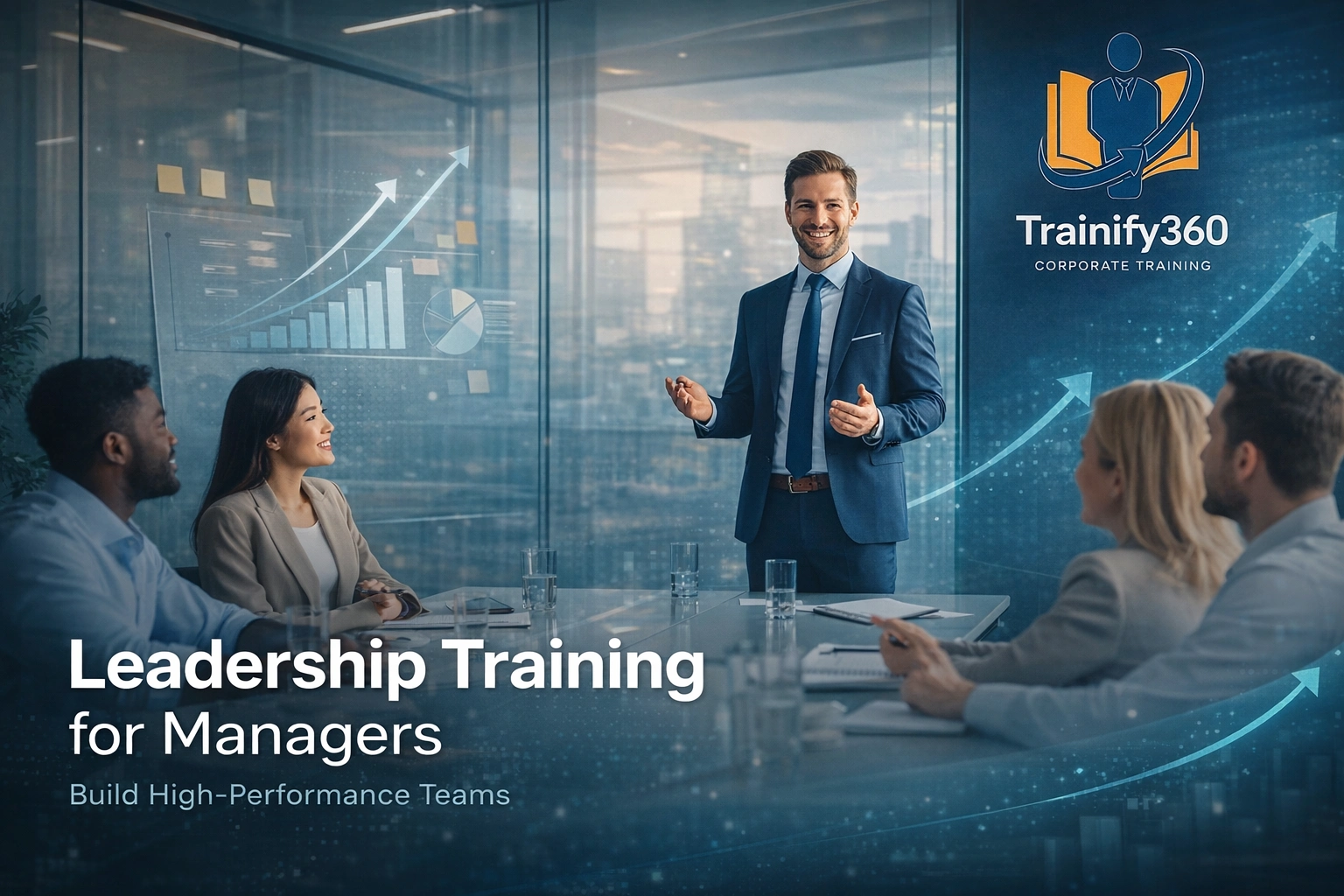
Leadership training for managers has become a decisive factor in whether organizations scale performance or struggle with execution gaps. In many enterprises, strategy is not the constraint—managerial capability is. Teams fail to deliver not because of lack of intent, but due to inconsistent leadership, unclear accountability, and limited performance coaching at the managerial level.
This challenge is intensifying. As organizations adopt hybrid work models, digital workflows, and cross-functional structures, managers are expected to lead with greater agility, influence without authority, and deliver outcomes under increasing complexity. Yet, most organizations still rely on fragmented or event-based training interventions that do not translate into sustained performance improvement.
A well-designed approach to leadership training for managers addresses this gap by building leadership capability as a structured, measurable, and scalable system. This guide outlines how enterprise leaders can design leadership development initiatives that directly contribute to building high-performance teams and driving business outcomes.
Why Leadership Training for Managers is a Business-Critical Investment
Leadership capability at the managerial level is one of the strongest predictors of team performance. However, it is often underdeveloped due to promotion practices that prioritize technical expertise over leadership readiness.
Insights from Harvard Business Review suggest that employees do not disengage from organizations—they disengage from ineffective managers. Similarly, Gartner research highlights that managerial effectiveness has a direct influence on productivity, engagement, and retention.
From a business standpoint, leadership training for managers contributes to:
- Consistent execution of organizational strategy at the team level
- Stronger alignment between business objectives and day-to-day operations
- Improved employee experience and engagement
- Reduced attrition and improved talent retention
- Enhanced decision-making speed and quality
Organizations that embed leadership training into their capability-building strategy create a performance multiplier effect, where improved managerial effectiveness drives sustained business impact.
Defining the Capabilities That Drive High-Performance Teams
Leadership training must be anchored in clearly defined capabilities. Without a structured competency model, development efforts become inconsistent and difficult to scale.
Strategic Alignment and Decision-Making
Managers must be equipped to interpret business priorities and translate them into actionable team-level execution. This includes prioritization, problem-solving, and making decisions under uncertainty.
Performance Ownership and Accountability
High-performance teams operate with clarity and discipline. Managers need to establish measurable goals, track progress consistently, and reinforce accountability without creating dependency.
Coaching for Capability Development
The role of a manager is evolving from supervisor to capability builder. This requires the ability to identify skill gaps, provide timely feedback, and support continuous development within the team.
Communication and Stakeholder Influence
Managers must align diverse stakeholders, communicate expectations clearly, and navigate conflicts effectively to maintain team cohesion and performance.
Emotional Intelligence and Team Effectiveness
Research from Deloitte indicates that leaders with strong emotional intelligence are significantly more effective in driving team performance. Managers must be able to build trust, manage stress, and foster collaboration.
These capabilities form the foundation of any impactful leadership training initiative.
Building a Structured Leadership Training Architecture
Organizations that achieve measurable outcomes from leadership training do not rely on isolated programs. Instead, they build integrated learning ecosystems aligned with business performance.
Step 1: Diagnose Capability Gaps
A structured Training Needs Analysis (TNA) is essential. Using the ADDIE framework, organizations must assess current leadership capabilities, identify performance gaps, and align development priorities with business objectives.
Step 2: Design Learning with Instructional Rigor
Leadership development should be guided by established frameworks such as Bloom’s Taxonomy, ensuring that learning progresses from basic understanding to application and strategic thinking.
The 70:20:10 model further strengthens design by emphasizing experiential and social learning over purely formal instruction.
Step 3: Enable Learning Through Multiple Channels
Modern leadership training requires a blended approach that integrates:
- Facilitated workshops for concept clarity
- Virtual learning for scalability
- Digital platforms for continuous access
- Workplace application through real assignments
Step 4: Drive Behavioral Change Through Reinforcement
Without reinforcement, learning does not translate into action. Organizations must embed mechanisms such as coaching, peer learning, and structured feedback loops to sustain behavioral change.
Step 5: Measure What Matters
Using the Kirkpatrick Model, organizations should evaluate learning effectiveness at multiple levels, including behavioral change and business impact. Metrics should be directly linked to performance outcomes rather than limited to participant feedback.
Leadership Development Approaches That Deliver Results
Traditional training formats are insufficient for building high-performance teams. Organizations must adopt approaches that focus on application and performance enablement.
One effective approach is capability-based development, where leadership training is aligned with specific roles and business requirements. This ensures relevance and improves adoption.
Experiential learning is another critical component. Managers learn most effectively when they apply concepts in real work scenarios, solve business problems, and reflect on outcomes.
AI-enabled learning systems are increasingly being used to personalize development journeys, identify capability gaps dynamically, and predict leadership readiness.
Simulation-based learning environments also add value by allowing managers to practice decision-making, handle complex situations, and develop strategic thinking in a risk-free setting.
These approaches ensure that leadership training moves beyond knowledge transfer and becomes a driver of performance transformation.
Why Leadership Training Initiatives Fail in Many Organizations
Despite significant investment, many leadership training programs fail to deliver meaningful outcomes. The reasons are often structural rather than operational.
A common issue is the reliance on one-time workshops. Without continuity, reinforcement, and real-world application, learning fades quickly.
Another challenge is the lack of alignment with business priorities. When training is not linked to organizational goals, it becomes disconnected and ineffective.
Generic content also limits impact. Programs that are not tailored to the organization’s context fail to resonate with participants.
Additionally, many organizations do not measure outcomes effectively. Without clear metrics, it is difficult to assess impact or improve future initiatives.
Finally, there is often an overemphasis on knowledge rather than behavior. Leadership effectiveness is demonstrated through actions, not concepts.
According to McKinsey, capability-building initiatives succeed when they are integrated into the organization’s operating model and supported by leadership commitment.
Mid-Article CTA: Evaluate Your Leadership Capability Maturity
If your organization is investing in leadership training but not seeing measurable improvements in team performance, it is critical to reassess your approach.
A structured leadership capability evaluation can help you:
- Identify gaps in managerial effectiveness
- Align development initiatives with strategic priorities
- Establish measurable performance benchmarks
- Design a scalable leadership development roadmap
This ensures that leadership training becomes a business enabler, not just a learning initiative.
Measuring the Business Impact of Leadership Training
For enterprise leaders, the effectiveness of leadership training must be validated through measurable outcomes.
Organizations should assess improvements in areas such as team productivity, employee engagement, retention, and overall business performance. Leadership development also influences succession planning and internal mobility, which are critical for long-term sustainability.
A robust measurement approach includes comparing performance before and after training, tracking behavioral changes over time, and linking improvements to business metrics.
Insights from the World Economic Forum indicate that organizations investing in structured reskilling and leadership development are better positioned to adapt to changing market conditions and maintain competitive advantage.
This reinforces the need for leadership training programs that are data-driven and outcome-oriented.
Scaling Leadership Training Across the Enterprise
As organizations grow, leadership capability must scale across functions, geographies, and business units. This requires a balance between consistency and customization.
A standardized leadership framework ensures alignment across the organization, while contextual customization ensures relevance to specific roles and industries.
For example, leadership requirements in technology environments often emphasize agility and innovation, while manufacturing environments prioritize operational discipline and process efficiency.
The ability to scale leadership training effectively determines whether organizations can sustain high performance over time.
The Trainify360 Perspective on Leadership Training
Trainify360 approaches leadership training as a capability transformation system, not a standalone program.
The methodology integrates:
- Structured frameworks such as ADDIE, Bloom’s Taxonomy, and the Kirkpatrick Model
- Customized learning journeys aligned with business strategy
- AI-enabled platforms for scalable and personalized learning
- Continuous measurement linked to performance outcomes
This approach ensures that leadership training contributes directly to workforce capability development, improved team performance, and measurable business results.
Conclusion
Leadership training for managers is a foundational element in building high-performance teams and achieving sustained business success. Organizations that invest in structured, scalable, and outcome-driven leadership development create a strong execution advantage.
The shift required is clear: leadership training must move from isolated interventions to integrated capability-building systems that align with business strategy and deliver measurable impact.
Trainify360 partners with organizations to design leadership training initiatives that are deeply aligned with enterprise goals, ensuring that managers evolve into leaders who can drive performance, enable teams, and sustain growth.
To build high-performance teams, leadership training must be approached not as a program, but as a strategic transformation journey.
Explore related insights:
- Leadership Development Frameworks for Enterprises
- Corporate Training ROI Measurement Guide